The Client's Request
I received an email from a collector who had recently acquired an old book and was curious about its history. They'd noticed the date 1868 inscribed on the first page, with a publication date around 1854, and the title was Machiavelli's History of Florence. They weren't looking to sell it—just wanted to know more about what they had.
The message was straightforward: "Just looking to know more about it to be honest and came across your page that seems to offer something that might be useful for this." Photos were attached, along with an offer to provide anything else needed to begin.
It was the kind of inquiry I love—someone genuinely interested in the story behind an object, not just its price tag.
The Investigation
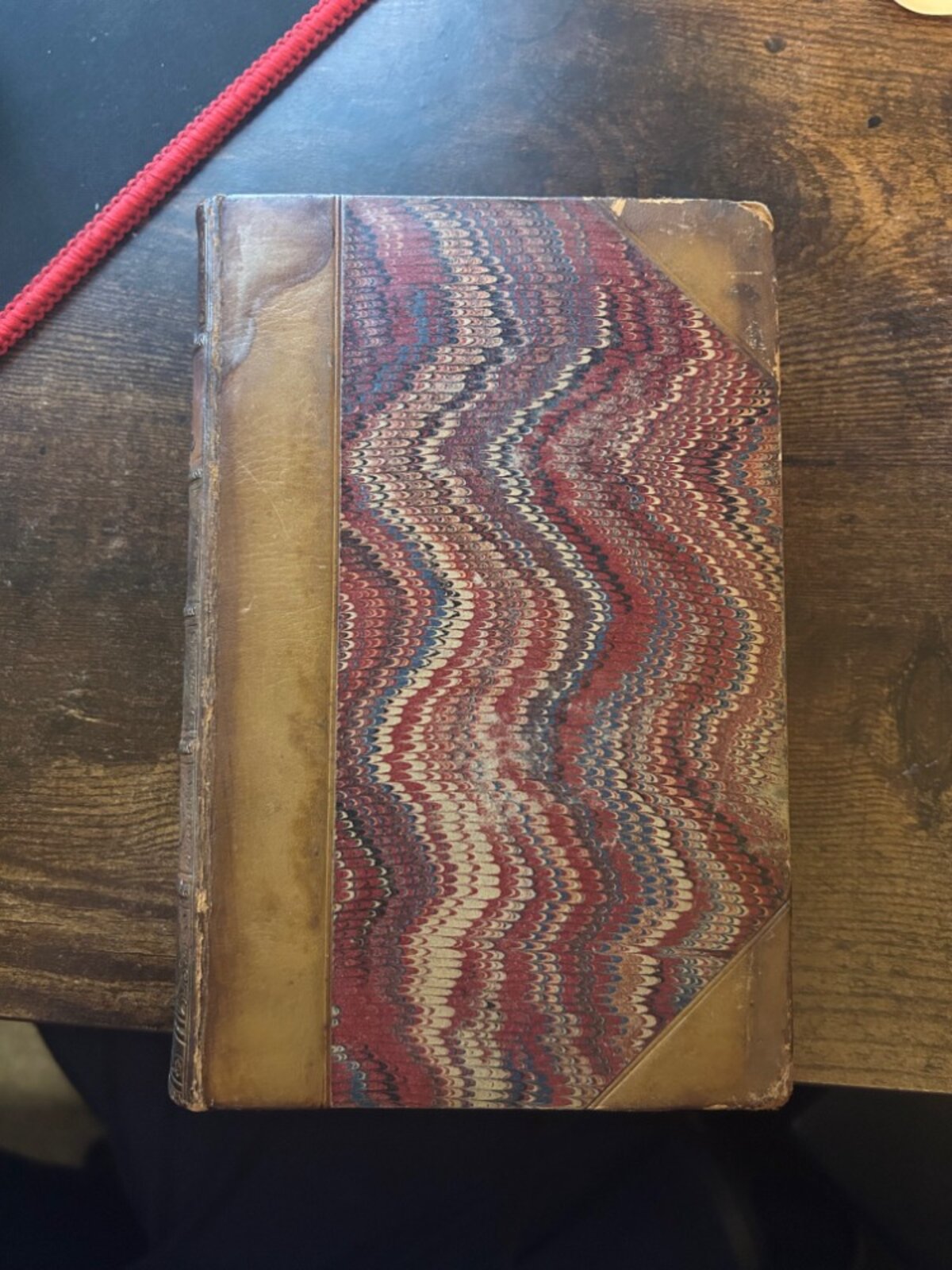
From the photos provided, I could see this was no ordinary paperback. The half-leather Victorian binding, marbled boards, and worn gilt spine all pointed to quality craftsmanship from the mid-19th century. This was a premium volume, likely purchased by someone with scholarly ambitions.
I started by identifying the publisher. The imprint revealed it was printed by Henry G. Bohn in 1854—a major name in Victorian publishing. Bohn's "Libraries" brought affordable yet respectable editions of classics, history, and philosophy to middle-class readers across Britain. His mission was to democratize learning, and this Machiavelli volume was a perfect example.
The printer, J. Haddon & Son of Castle Street, Finsbury, added another layer. Finsbury was a bustling center of London's printing trade, and Haddon was known for high-quality work. The binder remained unknown, though likely another London firm of similar caliber.

Deciphering the Inscription
The handwritten inscription—"Th. Pitts, Nov 12, 1868"—required more detective work. After consulting handwriting experts and cross-referencing historical records, I determined it was short for Thomas Pitts, likely an educated gentleman of the professional or clerical class residing in London during the 1860s.
The date suggested a personal mark of ownership rather than the original purchase date—perhaps gifted, inherited, or simply the day Mr. Pitts claimed it for his library. While deeper biographical details remained elusive, the inscription added a human dimension to the artifact.
Historical Context
The timing of this edition is significant. Mid-19th century Britain was captivated by the Italian Risorgimento—the unification movement sweeping the Italian peninsula. English readers turned to Machiavelli not just for The Prince, but for his broader historical writings on Florence and Italian statecraft. Bohn's 1854 edition arrived at precisely the right cultural moment.
What I Found
Client wanted answers fast, so I kept updates rolling in as I dug. Three weeks later, here's what the report covered:
- The publisher's history and significance (Henry G. Bohn)
- The printer and bindery context (J. Haddon & Son, Finsbury)
- Analysis of the Victorian binding and its condition
- The 1868 inscription and probable owner (Thomas Pitts)
- Contents: The History of Florence, The Prince, The Affairs of Italy, and related tracts
- Market comparisons and valuation
Valuation
Based on comparable sales and the book's condition—premium binding with moderate wear, historical inscription, and solid origins—I estimated its value in the £20–40 range, with potential for higher offers from the right buyer, particularly collectors of Victorian-era scholarship or Machiavelli enthusiasts.
Result
Client was happy. Their words: "I just needed a quick investigation into a book I acquired as I was interested in its past. I thought I'd try this supplier as a start and I was really impressed. Quick responses and the succinct report that was produced was exactly what I was looking for on this at a decent price."
What started as a curiosity buy turned into a documented piece of Victorian intellectual history—complete with a named owner, a dated inscription, and context for why this edition mattered. Now they know the story.